
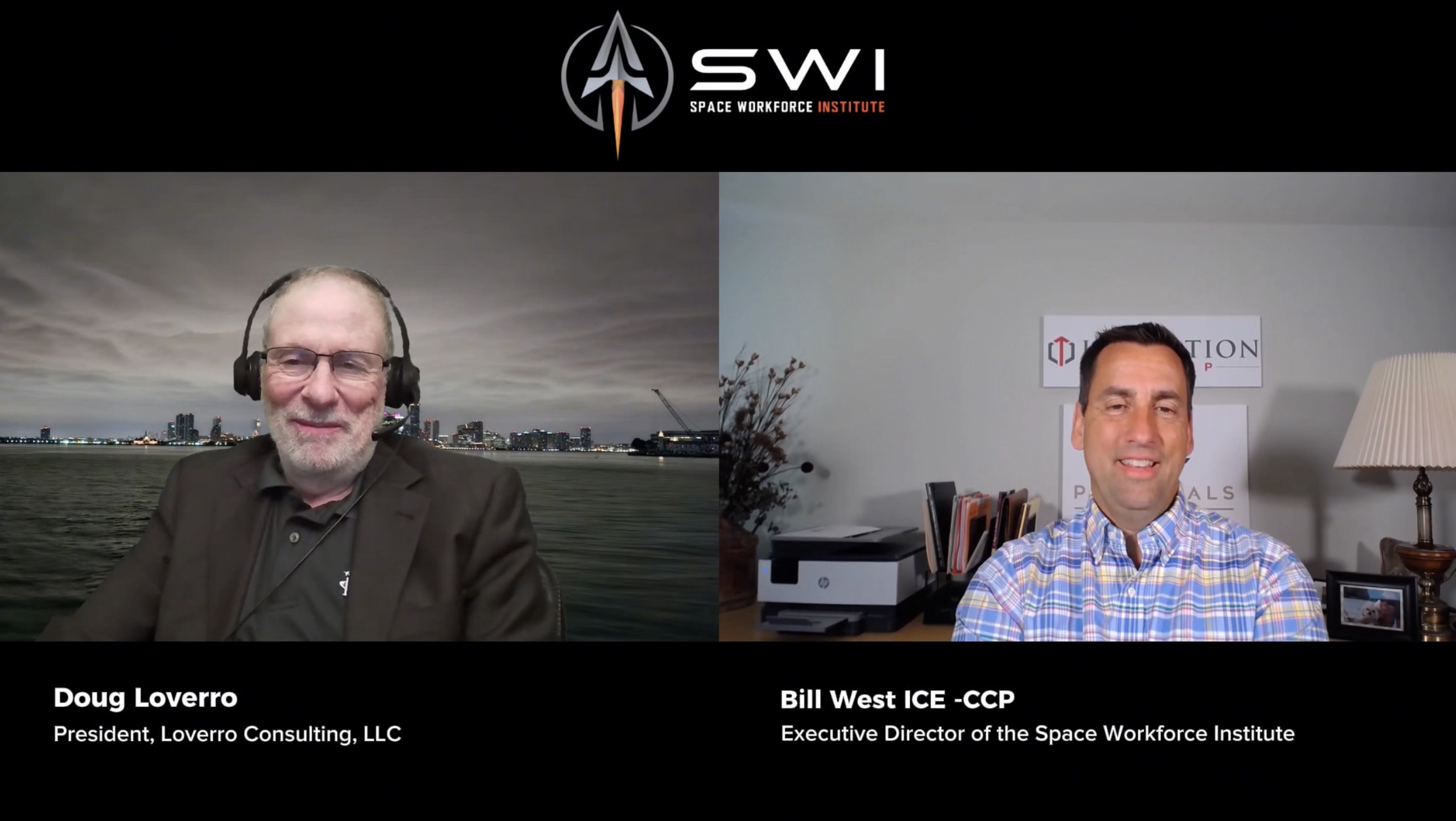
In a recent conversation with Bill West, Executive Director of the Space Workforce Institute, veteran space leader Doug Loverro offered a candid assessment of the space industry’s rapid growth and the structural workforce challenges beneath it. Doug is a recognized industry leader who serves on the Executive Advisory Committee of the Space Workforce Institute.
Loverro’s perspective is shaped by nearly five decades in national security and civil space. Over a 30 year uniformed career, he led major U.S. space programs including GPS, served at the National Reconnaissance Office, and later held senior space policy roles in the Pentagon that helped shape the environment leading to the creation of the United States Space Force. Today, he continues advising government and industry and teaches at institutions such as the University of California San Diego and the Naval War College.
The interview centered on an urgent theme: the space economy is expanding rapidly, but the workforce pipeline is not keeping pace. According to Loverro, this gap presents one of the most serious risks to long term leadership in space.
You can watch the full interview here.
A $600 Billion Industry Expanding Quickly
Loverro pointed to the extraordinary growth of the global space economy.
“The space economy is now valued at 600 billion dollars,” he noted. “That’s at least 200 billion more than it was just a few years ago.” Projections are even more ambitious. “I’ve seen predictions of that number going to 1 trillion. The latest prediction I saw was 4 trillion.”
However, he emphasized that even these numbers only represent direct economic activity. “That’s only the direct impact of space. There’s the indirect impact. All the things we use space for.” The indirect impact, navigation, communications, defense systems, financial infrastructure, agriculture, and more, is far larger.
Despite this growth, Loverro warned that the United States is facing serious execution challenges.
“We’re trying to get back to the Moon, right? And we’re having problems. Quite frankly, NASA is not on a path to get back to the Moon by 2030, which is embarrassing.”
For Loverro, these challenges are not simply technical. They are fundamentally about people.
The Workforce Constraint Beneath the Growth
A central theme of the discussion between Loverro and West was the widening gap between industry expansion and workforce supply.
“We have always enjoyed in the U.S. the notion that our universities and colleges produce the number of people we need to support industries,” Loverro explained. “But that’s actually only kind of true.”
Engineering talent is increasingly pulled toward AI, robotics, and other high growth sectors. “You’re competing for those engineers. Where are they going to focus?” But the challenge is broader than engineers alone.
“To make a space system happen, it’s not just a design. It’s everything that goes below it.” He emphasized technicians, electronics specialists, manufacturing professionals, and those working with advanced materials. “All of these things require trained people.”
Companies have industrialized satellite production, but industrial growth without workforce alignment creates bottlenecks. “The space industry increases in size faster than the talent supply,” he stated plainly.
Defining What the Industry Actually Needs
Loverro was clear that solving the workforce gap requires more than encouraging students to pursue space careers. It requires structure.
“The most important thing is for the industry to express their needs,” he said. “Tell us we need people who are qualified in space.”
Without clearly defined job roles and competency standards, education and training programs cannot align effectively. Mid career professionals from adjacent industries also lack a roadmap for transition. “How do we make sure that people who graduated 25 or 30 years ago can come in with the right skills?” he asked.
He drew a comparison to other industrial sectors where skill requirements are explicit and standardized. “To weld something for a car is not the same thing as welding something for your bike in the back.”
The implication is straightforward. As space manufacturing becomes more advanced and more industrialized, precision in workforce preparation becomes just as important as precision in engineering.
In that context, Loverro noted that organizations focused on workforce standards are “going to be critical in helping to develop those standards and helping to make sure they are acknowledged.”
He responded positively to the concept of structured bridging programs that allow welders, project managers, and other skilled professionals to enter the space sector with clearer competency alignment. Expanding the workforce, in his view, is not simply about attracting more people. It is about defining what qualified means and ensuring that definition is shared across industry and academia.
By developing structured, industry recognized certifications, the Space Workforce Institute is working to translate industry demand into clear pathways. This gives employers a shared language, gives educators alignment targets, and gives professionals confidence that their skills meet industry expectations.
Rather than treating credentials as symbolic badges, Loverro views them as foundational infrastructure for a scaling industry. As the space sector industrializes and production expands, clarity around skills, qualifications, and competencies becomes essential to sustaining growth. As a member of SWI’s Executive Advisory Committee, his support reflects that belief. In his view, workforce standards are not peripheral to space leadership. They help make it possible.
Building the Foundation for Growth
Doug Loverro’s insights underscore a critical reality. The space economy is expanding rapidly. Industrialization is accelerating. Competition is intensifying.
Yet growth without defined workforce standards creates fragility.
Through industry aligned certifications and credentials, the Space Workforce Institute is working to close the talent gap and create credible pathways into the space sector. By helping industry clearly articulate its needs and translating those needs into recognized credentials, SWI supports the kind of structured workforce development Loverro argues is essential.
As the space economy moves toward the trillion dollar mark, Loverro’s message is steady. Growth alone will not secure leadership. A workforce prepared to meet clearly defined standards will.
The Space Workforce Institute develops industry driven professional certifications designed to align employers, academia, and professionals across the global space sector. Learn more about SWI certifications and standards at the SWI website.
Watch the full interview with Doug Loverro here.